Friday, October 21, 2016

Political Economy of the Barbie Doll

The first Barbie Doll was created in 1959 by a woman named Ruth Handler and it was manufactured by the American toy company Mattel Inc. Handler had a young daughter (Barbara) who enjoyed playing with dolls but she would often pretend that her baby dolls were adults and gave them adult roles and jobs. During a trip to Germany with Handler’s family, Ruth discovered a doll that was based of a popular female comic book character. The doll’s name was Build-Lilli who was based on a popular comic book at the time. Lilli was a workingwoman who was not ashamed of using men as a way to get what she wanted in the workplace. Lilli’s character was racy and sexual, she often teased and flirted with people in her office often joking about using men for money. The doll came in two sizes, each with different hair colors. Lilli wore changeable clothing that was based off of 50’s fashion trends. This doll’s target audience was adults at first, but kids enjoyed the doll because they could change her in and out of clothing and accessories that were available if one wanted to buy them separately. This was the doll that Handler used as inspiration for creating her Barbie Doll, which was named after her daughter.


Image result for bild lilli

Photo of the Lilli doll above 

The doll was first introduced on March 9th 1959 at the American International Toy Fair in New York. Barbie was introduced as a teenage model dressed in a zebra printed one piece swimsuit with her hair (either blonde or brunette) in a ponytail. She had adult features such as long legs, a tiny waist, hips, breasts, and a sexual/ mysterious side glance. Barbie was unlike any child toy on the market at the time. Handler’s goal was to create a doll that would represent what every young girl might hope for in the future.
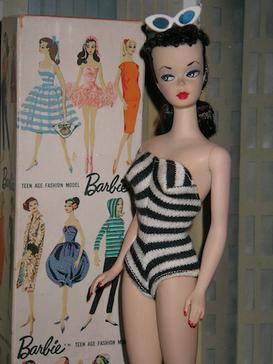
Image result for first barbie doll
Photo of the first Barbie Doll

The first Barbie Dolls were manufactured in Japan and their clothes and accessories were handcrafted by Japanese homeowners. During the early stages of production the company that created the Bild-Lilli sued Mattel for taking their doll and copying it. The first Barbie Doll and Bild-Lilli doll are extremely similar with the same hip joint, hairstyle and even face. Louis Marx and Company accused them of claiming the idea and creation of Barbie was completely original to them when really they had stolen the idea from Bild-Lilli. The case was settled in court and Mattel bought the copyright and patent for Lilli for $21,000.
When the doll first came out some parents were skeptical of the way teenage Barbie came across. She was curvy, half dressed, and wore a promiscuous look on her face. However, by the end of the year 350,000 Barbie Dolls were purchased and Ruth Handler’s company started to take off. In 2016 Barbie Dolls are being manufactured mainly in China but also in Indonesia and in Malaysia. Since the Barbie Doll first came out it has changed drastically, introducing new dolls, animals, occupations, you name it. The company has grown to be very successful, it has been estimated that over one billion dolls have been sold worldwide, with one Barbie being sold every 3 seconds. 


Tuesday, October 4, 2016

Cultural Artifact: Barbie Doll

The cultural artifact that I would like to follow for the rest of the semester is a Barbie Doll. Barbie Dolls have always been interesting to me because when I was a child my mom didn’t allow us to buy them, she always talked about them like they were silly stupid toys that were not good for our self esteem. My mother was like this about a lot of things, she wanted us to be strong independent girls who were aware of things such as undertones in Disney princess movies that made women look dependent and weak, or the unrealistic images of Barbie Dolls, Bratz Dolls etc.… In the end, I turned out alright I’d say. She raised me right and I will be forever grateful for that, but even now, my fascination with Barbie Dolls continues. My mother never had strict rules against Barbie Dolls being in the house, if they were given to us as a gift that was the exception, we accepted the doll with a thank you and a smile, but we knew she was not a fan, and even as a child I agreed in a way. I knew there were differences between a Barbie who was tall and skinny with blue eye shadow, pink lips, long eyelashes and twenty pairs of microscopic pumps that somehow disappeared almost immediately after leaving the package, and my American Girl Doll that came with its own historic background and character’s story  that usually involved leadership, independence, creativity, or some other positive quality a mother might want to instil into their young girls. I could see where my mother was coming from.
Most people are aware of the controversy behind Barbie Dolls, mostly people have an issue with their perfect little plastic bodies. So skinny and tall, so shiny and beautiful. Its just not realistic at all and that’s where the problem lies for most people. Barbie dolls have been under fire by feminists, the media, and people who promote positive body images for years and years. The Barbie company has done things to try and combat these idea like create a doll who is less busty, less thin, and who actually resembles a typical female body, but I am not to familiar with other steps they may have taken to win over crowds that may be less than enthusiastic about Barbie Dolls quite like my mother and I.
Another interesting thing about Barbie Dolls that make them a great artifact to study is the sheer amount of time they have been around. The first Barbie was created in 1959; they have been evolving ever since. They have seen wars, they have seen fashion trends, they have seen changing gender roles and images, they have seen technology flourish, they were a part of all these things in their own way, and this is what makes them so culturally rich. Barbie Dolls have lived in different houses, they have driven all kinds of cars, been in all kinds of professions, had thousands of different outfits, different pets, different boyfriends, and they have lived in different countries. I am excited to research this artifact in depth and learn more about Barbie’s life story through the years and what it might look like in the future.